
To get a certified copy of a will, contact the clerk of the court where the will is filed. Start with the court that handles estates in the county where the deceased person lived. Ask whether the will is on file, how to request certification, and what fees apply.
A certified copy confirms that the document matches the will in the court’s official record. However, it does not establish an executor’s authority by itself. Executors generally need court appointment and letters testamentary or letters of administration to act for an estate. Simplified estate procedures may require different documents.
If the court cannot locate the will, first check whether someone filed it elsewhere or deposited it without opening probate. If no filing exists, contact the person holding the original. You can also search The U.S. Will Registry to learn whether its location was registered.
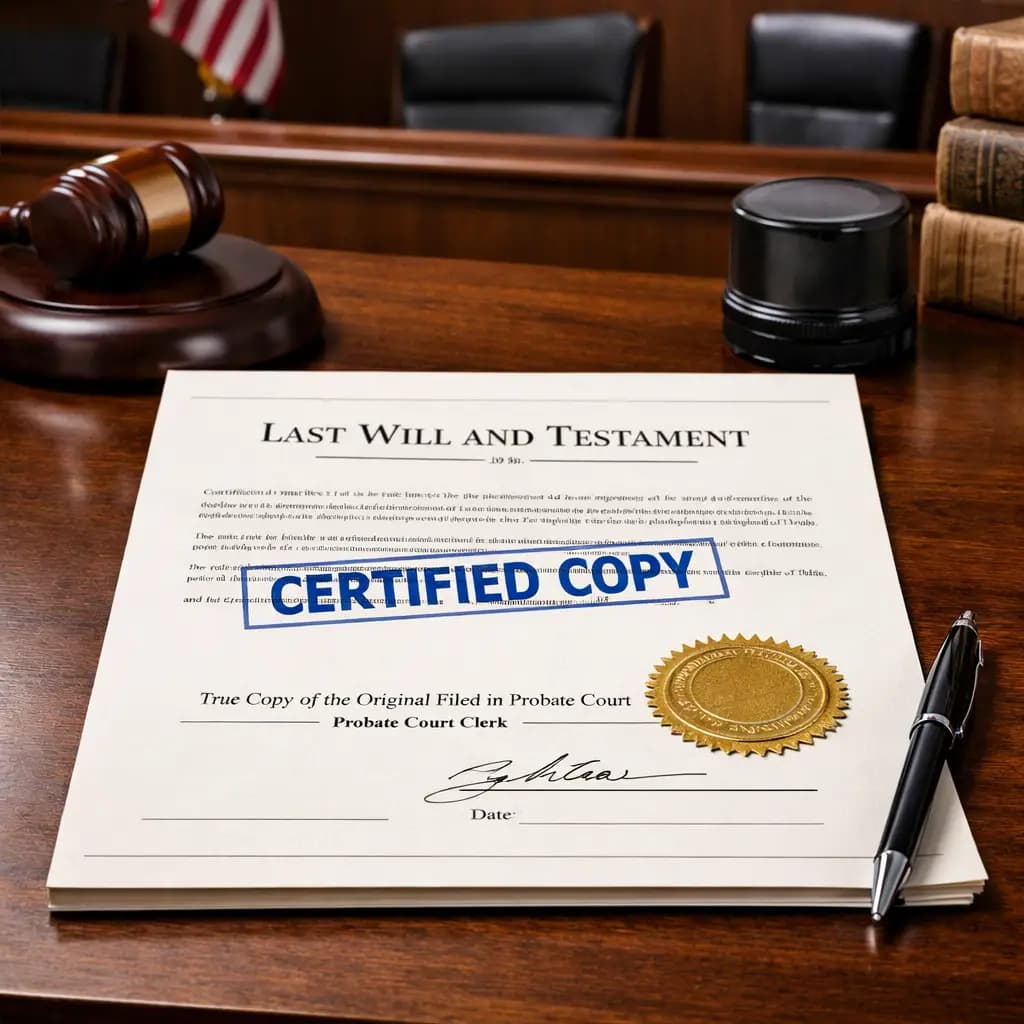
A certified copy of a will is a copy that an authorized court official certifies against the court’s record. Certification may include a signature, stamp, seal, or electronic certification. The format depends on the court.
This certification tells the recipient that the copy accurately reproduces the document on file. It does not mean the court has ruled that the will is valid. Filing a will, admitting it to probate, and appointing an executor are separate steps.
For example, a court may have a will on file before anyone starts estate administration. The clerk may be able to certify that document even though no executor has received authority to act.
Both versions help families understand the will. The difference is whether the court certifies the copy against its official record.
| Feature | Regular copy | Certified copy |
|---|---|---|
| What it contains | A reproduction of the will | A reproduction with court certification |
| Main purpose | Reading, reviewing, and sharing the will | Providing an officially certified reproduction when required |
| Court confirmation | No certification attached | Confirms the copy matches the court’s record |
| Executor’s authority | Does not establish authority by itself | Does not establish authority by itself |
| Typical cost | Copy or download fees may apply | Copy fees and a certification charge may apply |
A regular copy can also have legal uses. For instance, a court may consider a copy when the original is lost. However, admitting a lost will requires additional proof under state law.
Before paying for certification, ask the recipient which version it needs. An online download may be enough for review, while a particular filing may require certification.
No. A certified copy of a will does not, by itself, authorize someone to manage the estate.
The will identifies the person nominated to serve as executor. The court generally must appoint that person before they exercise the powers of an estate representative. The court then issues documents commonly called letters testamentary or letters of administration. Terminology varies by state.
These documents establish the representative’s appointment. A certified will, meanwhile, documents what the will says.
Consequently, a bank may require certified letters and a death certificate before releasing estate funds. Other transactions may require a court order or documents for a simplified estate procedure. Ask the institution or your estate attorney what applies.
You may need a certified copy when another court, government office, attorney, or institution requests one. For example, an estate proceeding in another state may require certified probate documents.
A certified will may also support a transaction involving estate property. Nevertheless, it may be only one part of the required paperwork.
Do not assume every bank, insurer, or investment firm needs the will. Accounts with named beneficiaries often pass through a separate claim process. Life insurance and retirement benefits payable to individual beneficiaries commonly require claim forms and a certified death certificate.
If the estate is the beneficiary, different requirements may apply. Similarly, transferring real estate may involve probate orders, deeds, or other documents. Requirements depend on ownership, state law, and the transaction.
First, contact the court handling estates where the deceased person lived at death. Depending on the state, this may be a probate court, Surrogate’s Court, or a division of another court.
If the person owned property elsewhere, another estate proceeding may exist. Ask which court holds the document you need. Our guide to finding a will in probate court explains how to begin.
Have the deceased person’s full legal name and date of death available. Also provide the case number if you know it.
If you cannot find a case online, ask the clerk to check for a deposited will. A will may be on file without an active estate administration case. Older records may require an archive search.
Next, ask whether the will is available for inspection and whether the clerk can issue a certified copy. Public access and certification procedures vary.
Also ask whether the court offers paper copies, electronic certified copies, or both. Confirm that the intended recipient accepts the format you plan to order.
Courts may accept requests online, in person, or by mail. Follow the clerk’s instructions and identify the document clearly.
Request the will and any codicils you need. A codicil is a document that changes or adds to a will. If you need related court orders or letters, request those separately.
Ask about copying charges, certification charges, delivery costs, and accepted payment methods. Fees vary by court and document length.
Before ordering several copies, confirm how many you actually need. Some recipients accept electronic certification, while others require their own paper copy.
Finally, ask when the copies will be ready. Some requests can be completed quickly. Mailed requests and archived files may take longer.
Check that the delivered copy includes every requested page and the court’s certification. If something is missing, contact the clerk before submitting it elsewhere.
Possibly. The important question is whether the court already has the will and can certify it under its procedures.
Depositing a will does not necessarily open probate administration. Some states require the custodian to deliver the original after death, even when no administration is planned.
Therefore, a missing online probate case does not prove that the court lacks the will. Ask the clerk about deposited wills and the process for requesting copies.
If the court does not have the will, it cannot certify a copy against a court record it does not hold. Start by locating the original and learning the filing requirements.
Our guide explains how to find the attorney who wrote a will.
The person holding the will may have a legal duty to deliver it to court. Deadlines and procedures vary by state. If someone refuses to produce it, an estate attorney can explain available court remedies.
A missing original does not automatically mean the estate must proceed without a will. Some courts allow a copy or other evidence of a lost will when the required proof is available.
However, a photocopy does not automatically replace the original. State law may require proof of proper execution, the will’s contents, and why the original is missing. Questions about revocation may also arise.
An estate attorney can assess those requirements. Read our guide to a petition to admit a copy of a will for more information.
Wills in public court records are generally available to anyone, subject to access restrictions. You usually do not need to be a beneficiary to request an accessible public record.
Nevertheless, confidential filings, sealed records, and wills deposited during someone’s lifetime may have different rules. Ask the clerk about the particular record.
For further guidance, see are wills public record and who can get a copy of a will.
For a will on file with a court, request certification from that court’s clerk or authorized records office. Notary copy-certification powers vary by state. Many states restrict certification of court or public records.
Additionally, notarizing someone’s signature on a statement does not create a court-certified copy. Confirm the recipient’s requirements before using any alternative certification process.
There is no standard number that every estate needs. Make a list of the organizations requesting documents and ask what each requires.
Some may need certified letters rather than the will. Others may accept an electronic certified copy. Order additional paper copies only when they serve a known purpose.
Keep a record of your requests, fees, and submissions. This helps avoid unnecessary purchases and makes follow-up easier.
Store your original will securely and tell your nominated executor where to find it. Choose a location they can access through the appropriate process after your death.
You can also register your will’s location for free with The U.S. Will Registry. The Registry records location information; it does not store the will or its contents. Keep the registration current whenever the storage location changes.
For families searching after a death, every Registry search includes general estate settlement guidance based on their relationship to the deceased. Our guide to finding out if a will exists provides additional search steps.
Request it from the clerk or authorized records office of the court holding the will. Start with the court handling estates where the deceased person lived.
Fees vary. Ask about copying, certification, and delivery charges before placing your request.
No. Certification confirms that the copy matches the court’s record. The court’s decision to admit a will to probate is a separate matter.
A bank may request it, but the will alone generally does not establish authority over estate accounts. Ask whether you need court-issued letters, a death certificate, or other documents.
Possibly, if the court already holds the will and its procedures allow certification. Contact the clerk rather than assuming an estate administration must begin first.
Contact the drafting attorney, family, and nominated executor. Search for a registered location. If only a copy exists, ask an estate attorney about proving a lost will.
No. Requirements depend on the asset and how it transfers. Confirm the required paperwork with the institution or person handling the distribution.
This article provides general information. Requirements vary by state, court, and institution.
This article was reviewed for legal accuracy by Shawn Patrick Wolf, Esq. Mr. Wolf is Board Certified in Wills, Trusts and Estates and in Tax Law. He serves on the Board of Directors of the East Coast Estate Planning Council and the Palm Beach Tax Institute.
